How do you base64 vs hex encoding: what's the difference?
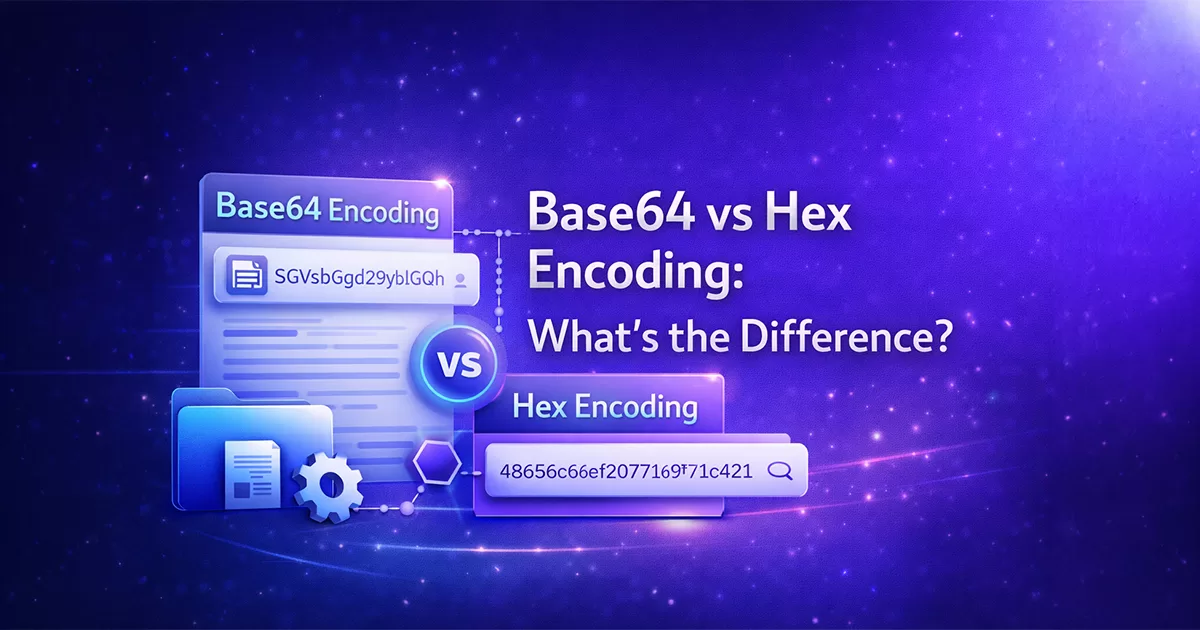
Base64 uses 64 characters, producing a 33% size overhead, while Hex uses 16 characters with a 100% overhead, making Base64 more efficient for transport and Hex better for human-readable debugging.
Base64 encodes binary data into 64 ASCII characters (A-Z, a-z, 0-9, +, /), producing a 33% size overhead. Hex (Base16) uses 16 characters (0-9, a-f) with a 100% overhead. Use Base64 for transport (email attachments, data URIs, JWT payloads), and hex for human-readable debugging (memory dumps, hashes, cryptographic keys).

Both Base64 and hex (hexadecimal) encoding convert binary data to text representation. But they use different character sets, produce different output sizes, and are used in different contexts. Choosing the wrong one for a given situation creates unnecessary overhead or compatibility issues.
How Each Encoding Works
Hexadecimal (Hex) Encoding
Hex represents each byte of binary data as two hexadecimal characters (0–9, a–f). One byte = 8 bits = two hex characters. Output uses only 16 characters: 0123456789abcdef.
Example: The text "Hi" in hex is 4869, "H" is byte 72 = 48 in hex, "i" is byte 105 = 69 in hex.
Size overhead: Hex output is exactly 2× the size of the input in bytes.
Base64 Encoding
Base64 represents three bytes of binary data as four characters, using a 64-character alphabet (A–Z, a–z, 0–9, +, /). Three input bytes = four output characters.
Example: "Hi" in Base64 is SGk=.
Size overhead: Base64 output is approximately 1.33× (33% larger) than the input.
Efficiency Comparison
| Property | Hex | Base64 |
|---|---|---|
| Character set | 16 chars (0-9, a-f) | 64 chars (A-Z, a-z, 0-9, +/) |
| Size overhead | 100% (2× input size) | ~33% (1.33× input size) |
| Output per byte | 2 chars | 1.33 chars |
| URL-safe by default | Yes | No (Base64url variant needed) |
| Human readability | Easy to read byte values | Harder to visually parse |
Base64 is more efficient, it encodes more data per character. Hex is simpler and more readable for byte-level inspection.
When to Use Hex
Cryptographic hashes: MD5, SHA-1, SHA-256 outputs are almost always represented as hex strings. "5f4dcc3b5aa765d61d8327deb882cf99" is an MD5 hash in hex, easy to compare, consistent length, no padding issues.
Colour codes: CSS hex colours (#FF5733) are hex encoding of RGB byte values.
Network addresses and MAC addresses: Typically represented in hex (00:1A:2B:3C:4D:5E).
Byte-level debugging: When you need to inspect exact byte values, hex makes each byte visually distinct as a two-character pair.
When to Use Base64
Embedding binary data in text formats: JSON, XML, and HTML don't natively handle binary. Base64 is the standard way to embed images, files, and binary data in text-based formats.
HTTP authentication headers: Basic Auth credentials are Base64-encoded.
JWT tokens: The three sections of a JWT are Base64url-encoded.
Data URIs: Embedding images directly in HTML/CSS: src="data:image/png;base64,iVBOR..."
API payloads: Sending binary data (files, images) inside JSON bodies.
The Most Common Confusion
Using hex when efficiency matters. For small strings and hashes, hex is fine. But for embedding images or files, hex doubles the size, a 100KB image becomes 200KB hex. The same image as Base64 is only 133KB. This is why Base64 became the standard for binary data embedding, not hex.
Base64url vs Standard Base64
Standard Base64 uses + and / which are special characters in URLs. Base64url replaces them with - and _ for URL-safe encoding without percent-encoding. JWTs use Base64url. Standard binary embedding uses Base64. If you're decoding a JWT and getting garbled output from a standard Base64 decoder, replace - with + and _ with / first.
Frequently Asked Questions
Is hex or Base64 more secure?
Neither is secure, both are encoding schemes, not encryption. Anyone can reverse either format without a key. For security, use actual encryption (AES, RSA). Use hex or Base64 only for data representation, not data protection.
Why do cryptographic hashes use hex instead of Base64?
Consistency and readability. Hex hashes are always exactly twice the bit-length in characters (MD5 = 128 bits = 32 hex chars). They're easy to compare visually, and the lowercase hex format is a consistent standard across all languages and tools. Base64 hashes would be slightly shorter but less standardised in practice.
Can I convert between hex and Base64?
Yes, both represent binary data, so you convert through the binary: hex → binary → Base64, or Base64 → binary → hex. Our Base64 tool handles the Base64 direction; for hex, you'd typically use a language function or script.
What encoding should I use for file uploads in APIs?
Base64 is the standard for embedding file content in JSON API bodies. Hex would work technically but produces files twice as large, which increases upload time and API payload size unnecessarily.
The Bottom Line
Use hex for hashes, byte-level inspection, and contexts where readability of individual byte values matters. Use Base64 for embedding binary data in text formats, HTTP headers, and APIs where efficiency matters more than byte-level readability. Encode and decode Base64 instantly with our free Base64 tool.
Frequently Asked Questions
Is Base64 a form of encryption?
No. Base64 is encoding, not encryption. Anyone can decode it in milliseconds. Use it for safe transport, never for secrecy. For secrecy, encrypt first, then Base64 the ciphertext.
Why does Base64 always end in =?
The = sign is padding to make the output length a multiple of 4. Two = signs mean the original ended on a byte boundary; one = sign means two bytes; no = means three or six.
Is hex faster than Base64?
Hex encodes and decodes faster (lookup table is smaller), but produces 50% larger output than Base64. For network transport, Base64 wins on bandwidth; for in-memory debugging, hex wins on speed.
Last updated: 21 May 2026 — content refreshed with AEO structure for AI engine extraction.